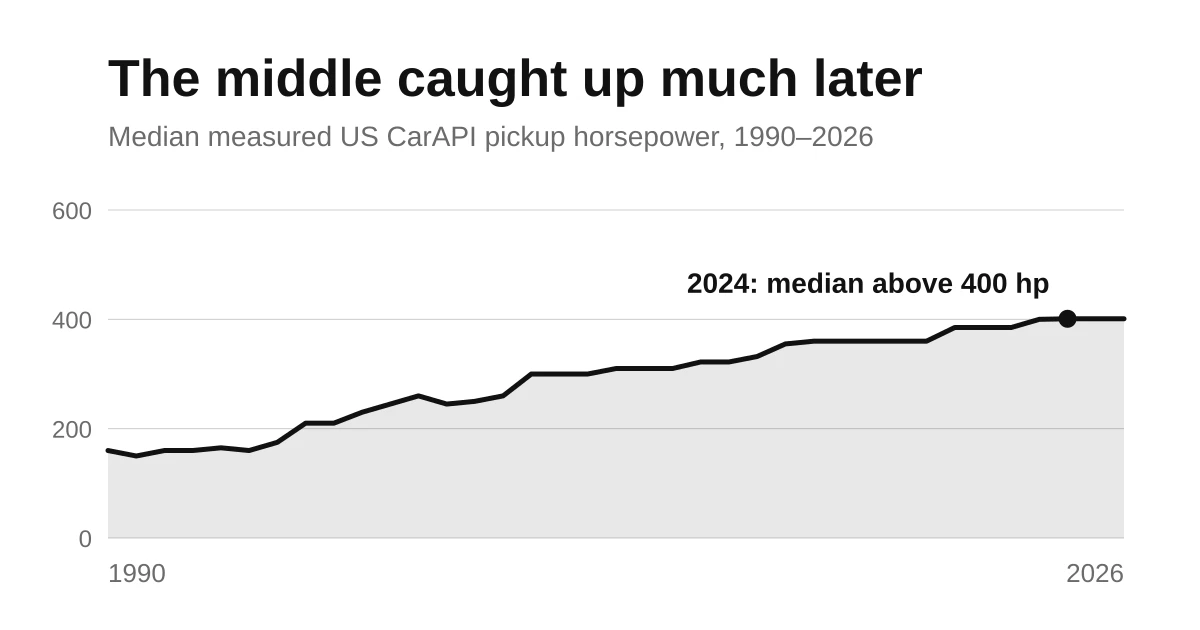
US pickup horsepower thresholds through 2026, with torque alongside.
The fast pickup arrived before the powerful middle
There is always one person who orders the hottest thing on the menu and then behaves as though everyone else has done the same. Performance pickups play that role. The first truck above 300 hp in this list appears in 1999. The middle does not clear that line until 2008. One spectacular pickup is not the average workday.
The first versions past 300, 400 and 500 hp
| Above, hp | First year here | Pickup version | hp | Torque, lb-ft | Trim median first above | Family median first above |
|---|---|---|---|---|---|---|
| 300 | 1999 | Ford F-150 SVT Lightning | 360 | 440 | 2008 | 2010 |
| 400 | 2004 | Dodge Ram Pickup 1500 SRT-10 | 500 | 525 | 2024 | 2025 |
| 500 | 2021 | Ram 1500 TRX | 702 | 650 | Not through 2026 | Not through 2026 |
The 1999 F-150 SVT Lightning is the opening act: 360 hp and 440 lb-ft. This is the petrol performance truck, not the later battery-electric Lightning. The shared name does not make the two vehicles one continuous engineering argument.
The next marker belongs to the 2004 Dodge Ram SRT-10, at 500 hp and 525 lb-ft. It clears 400 hp with some enthusiasm, but it does not pass 500. Sitting on the line is not crossing it. The first version in this list strictly above 500 is the 2021 Ram TRX, at 702 hp and 650 lb-ft. Restraint had apparently left the meeting.
These are firsts in this list, not certificates declaring that no earlier pickup could possibly have been stronger. The early list runs thin; the trucks were still there. What the named versions establish is a set of visible milestones, each attached to an actual version rather than a whole badge.
The middle took nine years, then twenty
The trim median first passes 300 hp in 2008, 9 years after that Lightning. It passes 400 in 2024, 20 years after the SRT-10. Neither median shown here gets above 500 hp by 2026. A 702-hp pickup can therefore exist without turning 500 hp into the ordinary middle of the range.
By 2010, even the middle pickup family here had cleared 300 hp. The 400-hp crossing waited until 2025. The Lightning and SRT-10 had long since made their entrance. Ordinary pickups took considerably longer to join the noise.
That distinction matters when comparing generations. A heroic top specification can make an old range look powerful. A new range can raise its ordinary engines without setting a dramatic new record. One measures the ceiling. The other tells you where most of the menu sits. Neither tells you what most people ordered.
Horsepower and torque through the middle
| Year | Median hp | Median torque, lb-ft | hp known/total | Torque known/non-EV total |
|---|---|---|---|---|
| 1990 | 160 | 235 | 371/371 | 371/371 |
| 1991 | 150 | 230 | 356/356 | 356/356 |
| 1992 | 160 | 235 | 352/352 | 352/352 |
| 1993 | 160 | 235 | 311/311 | 260/311 |
| 1994 | 165 | 235 | 310/310 | 277/310 |
| 1995 | 160 | 237 | 344/344 | 344/344 |
| 1996 | 175 | 265 | 357/358 | 344/358 |
| 1997 | 210 | 255 | 369/372 | 369/372 |
| 1998 | 210 | 255 | 360/360 | 360/360 |
| 1999 | 230 | 290 | 456/465 | 456/465 |
| 2000 | 245 | 290 | 450/450 | 450/450 |
| 2001 | 260 | 300 | 428/428 | 428/428 |
| 2002 | 245 | 293 | 459/459 | 459/459 |
| 2003 | 250 | 300 | 454/454 | 454/454 |
| 2004 | 260 | 330 | 650/650 | 650/650 |
| 2005 | 300 | 360 | 587/587 | 587/587 |
| 2006 | 300 | 360 | 696/696 | 696/696 |
| 2007 | 300 | 360 | 941/941 | 941/941 |
| 2008 | 310 | 365 | 786/786 | 786/786 |
| 2009 | 310 | 365 | 656/656 | 656/656 |
| 2010 | 310 | 365 | 567/567 | 567/567 |
| 2011 | 322 | 380 | 596/596 | 596/596 |
| 2012 | 322 | 380 | 569/569 | 569/569 |
| 2013 | 332 | 380 | 553/553 | 553/553 |
| 2014 | 355 | 380 | 524/524 | 524/524 |
| 2015 | 360 | 380 | 672/672 | 672/672 |
| 2016 | 360 | 380 | 714/714 | 714/714 |
| 2017 | 360 | 380 | 700/759 | 700/759 |
| 2018 | 360 | 380 | 755/755 | 755/755 |
| 2019 | 360 | 383 | 680/680 | 680/680 |
| 2020 | 385 | 429 | 654/654 | 654/654 |
| 2021 | 385 | 429 | 642/642 | 642/642 |
| 2022 | 385 | 429 | 737/737 | 726/729 |
| 2023 | 400 | 430 | 621/621 | 610/613 |
| 2024 | 401 | 464 | 557/562 | 543/543 |
| 2025 | 401 | 464 | 625/629 | 597/604 |
| 2026 | 401 | 445 | 537/537 | 511/511 |
Torque sits beside horsepower because a truck has jobs other than producing a large number for its tailgate. But peak torque is not a towing rating, and horsepower is not a payload allowance. Those require the particular configuration. The SRT-10 and TRX figures do not give every Ram of their year the same capabilities by association.
The decade-by-decade numbers
| Decade | Source grain | hp known/total | Torque known/total |
|---|---|---|---|
| 1980s | epa | 100/1667 (6.0%) | 33/1667 (2.0%) |
| 1990s | carapi | 3586/3599 (99.6%) | 3489/3599 (96.9%) |
| 1990s | epa | 42/781 (5.4%) | 34/781 (4.4%) |
| 2000s | carapi | 6107/6107 (100.0%) | 6107/6107 (100.0%) |
| 2000s | epa | 48/260 (18.5%) | 41/260 (15.8%) |
| 2010s | carapi | 6330/6389 (99.1%) | 6330/6389 (99.1%) |
| 2010s | epa | 205/257 (79.8%) | 177/257 (68.9%) |
| 2020s | carapi | 4373/4382 (99.8%) | 4353/4382 (99.3%) |
| 2020s | epa | 335/364 (92.0%) | 290/364 (79.7%) |
The useful answer is not simply that pickups gained horsepower. It is that the extreme and the ordinary moved on different schedules. The chilli enthusiast finished his plate long before the rest of the room changed its order.
Sources
- CarAPI — the named threshold versions and trim-grain horsepower/torque medians.
- EPA and DOE fuel-economy datasets — US pickup identities and model years; horsepower and torque on EPA rows are enrichment, not fuel-economy measurements.
- NHTSA vPIC — an enrichment source for known horsepower, not torque.
Explore
Compare four-cylinder pickups entering the half-ton range, the hybrid retreat and electric arrivals, and horsepower against fuel economy. Find pickup versions above 500 hp.