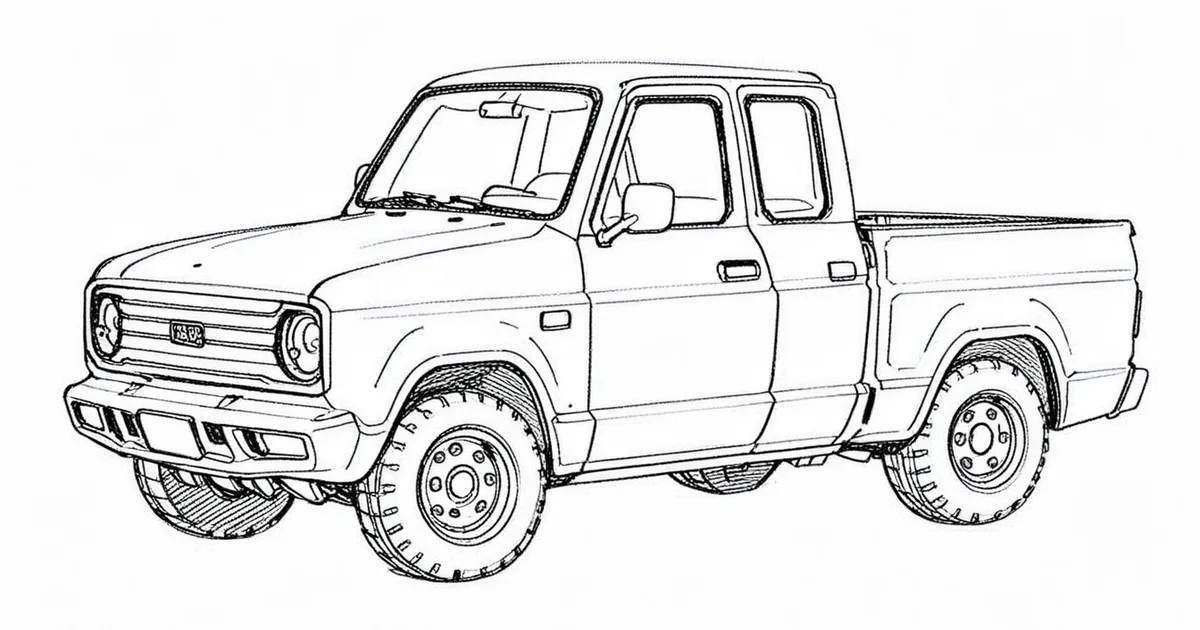
23,929 US pickup versions, 1984–2027.
The manual-transmission pickups we have tracked in the US
Imagine opening a kitchen drawer and discovering that every useful tool has been replaced by one button marked “convenience”. The pickup gearbox has suffered much the same tidying-up. In 1997, 95.1% of US pickup versions had a clutch pedal, across 28 models. In 2026 this list has one model left: the Toyota Tacoma.
The remarkable bit is not merely that the Tacoma survived. It is how quickly everyone else drops out of the rows. Ford, Chevrolet, Dodge, Nissan and Mazda each reaches a final manual model year in this list. What appears here as the normal gearbox becomes an enthusiast’s special request, then a nuisance on the order sheet, then Toyota’s lonely party trick.
The collapse of the manual pickup, year by year
| Year | Truck variants | Manual | Share | Models with a manual |
|---|---|---|---|---|
| 1985 | 316 | 183 | 57.9% | 31 |
| 1990 | 512 | 445 | 86.9% | 44 |
| 1995 | 420 | 385 | 91.7% | 34 |
| 2000 | 461 | 398 | 86.3% | 28 |
| 2005 | 599 | 296 | 49.4% | 25 |
| 2010 | 591 | 112 | 19.0% | 11 |
| 2015 | 688 | 20 | 2.9% | 4 |
| 2019 | 719 | 13 | 1.8% | 4 |
| 2020 | 699 | 9 | 1.3% | 2 |
| 2021 | 702 | 14 | 2.0% | 2 |
| 2022 | 797 | 13 | 1.6% | 2 |
| 2023 | 671 | 11 | 1.6% | 2 |
| 2024 | 614 | 10 | 1.6% | 2 |
| 2025 | 683 | 3 | 0.4% | 1 |
| 2026 | 580 | 3 | 0.5% | 1 |
| 2027 | 123 | 0 | 0.0% | 0 |
The last manual year we found for each nameplate
| Nameplate | Last manual year | Manual variants |
|---|---|---|
| Toyota Tacoma | 2026 | 217 |
| Jeep Gladiator | 2024 | 37 |
| Nissan Frontier | 2019 | 189 |
| GMC Canyon | 2019 | 116 |
| Chevrolet Colorado | 2019 | 115 |
| Ram 3500 | 2012 | 40 |
| Suzuki Equator | 2012 | 7 |
| Ford Ranger | 2011 | 475 |
| Ford F-350 Super Duty | 2010 | 537 |
| Ford F-250 Super Duty | 2010 | 340 |
| Dodge Ram Pickup 3500 | 2010 | 211 |
| Ford F-450 Super Duty | 2010 | 14 |
| HUMMER H3T | 2010 | 3 |
| Dodge Dakota | 2009 | 320 |
Why the manual pickup faded
Three forces did it, in descending order of weight. First, take rates collapsed. Once automatics matched manuals for towing and beat them on fuel-economy test cycles, the manual became a low-single-digit-percentage option that still demanded its own engineering, production and dealer support. The gearbox had acquired the economics of a village railway: cherished loudly, used by hardly anyone, and expensive whenever anyone tried to keep it.
Towing then removed the manual’s practical defence. Modern automatics could launch a loaded trailer cleanly, swap ratios without interrupting power and deliver repeatable test results without asking the driver to be a part-time gearbox technician. Finally, the diesel heavy-duty market — the manual’s last stronghold — moved to automatics as torque outputs climbed beyond what a driver-operated clutch could comfortably manage. The truck did not forget how to work. Its driver’s left leg simply lost the engineering argument.
The table makes the pace plain for the trucks we have tracked. Their manual share remains above 85% through the late 1990s, halves during the 2000s, then falls to a single nameplate in the decade after 2013. That is the list boundary, not the market’s obituary: the Mercedes-sourced G56 carried on in the Ram 2500/3500 through 2018. The inconvenient counterpoint is that automatics became better at the jobs buyers actually asked trucks to do. The manual did not lose a popularity contest alone; it lost the towing, test-cycle and torque cases as well.
Sources
The gearbox did not disappear in a puff of nostalgia. Here are the period numbers, the final full-size holdout and the hardware itself.
- US fuel-economy information — period economy figures for the trucks.
- Jalopnik, on the 2018 Ram 2500/3500 — press attribution for the Mercedes-sourced G56 six-speed as the final full-size manual pickup.
- The G56 gearbox — production history and the trucks it was fitted to.
Explore the trucks
If you wish to inspect the retreat yourself, start with the four-wheel-drive pickups that demanded a clutch pedal, then see which manual pickups survived beyond 2015, or how long the four-cylinder, rear-drive manual work truck lasted. Related: the disappearance of the cheap pickup — the same segment, the other extinction — and when the V8 actually peaked, where the answer runs the other way. The stronghold this page names in passing gets its own accounting in the diesel pickups we have tracked, which shows why diesels kept the clutch pedal longest. In the latest year on this list, one pedal survives. It belongs to the Tacoma.