There is a particular kind of person who will tell you, unprompted, at a barbecue,
that turbochargers are a modern fad for people who cannot cope with a proper engine. He is wrong in
an interesting way, because the fad he is complaining about is older than his shed. We tried all of
this in the eighties, decided we hated it, spent fifteen years pretending it never happened, and
then quietly did the whole thing again on a scale that makes the first attempt look like a rehearsal.
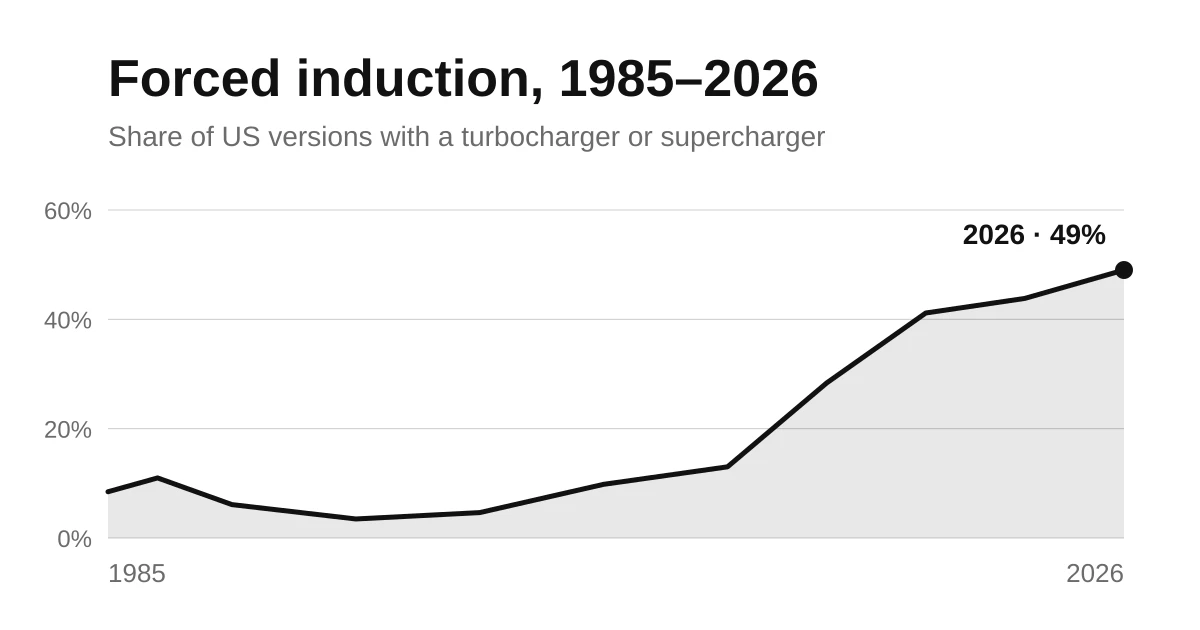
Turbocharged, supercharged and twincharged versions as a share of US versions with a filed aspiration.
The line opens at 8.5% in 1985 and climbs to 11.0% by 1987, which is the eighties turbo boom you half remember: the bonnet scoop, the boost gauge bolted somewhere it could be admired, the two-second pause between asking for acceleration and receiving any. Then it falls off a cliff. By 1996 forced induction is down to 3.2%, spread across just 25 model entries, and it took until 2009 to get back to where it had been in 1987.
The first turbo era was a party trick attached to an engine that was otherwise unimproved, and it
drove like one: laggy, thirsty, and with a reputation for fragility that its owners will happily
talk you through. Then engines got better on their own — multi-valve heads, proper injection,
variable timing — and for a decade the sensible way to get more power was to build a better
naturally aspirated engine. Turbocharging did not lose an argument. It lost its job.
Forced induction by model year
Versions offered for US sale with a filed aspiration, not sales figures. Twincharged versions count as forced and appear in neither split column.
Year
Versions
Forced
Share
Turbo
Supercharged
Model entries
1985
1,584
134
8.5%
134
0
67
1986
1,193
105
8.8%
105
0
68
1987
1,201
132
11.0%
132
0
79
1988
1,123
88
7.8%
88
0
56
1989
1,131
116
10.3%
112
4
69
1990
1,522
93
6.1%
91
2
47
1991
1,589
74
4.7%
73
1
48
1992
1,512
63
4.2%
59
4
43
1993
1,453
49
3.4%
45
4
34
1994
1,315
47
3.6%
43
4
31
1995
1,350
47
3.5%
39
8
32
1996
1,265
41
3.2%
34
7
25
1997
1,294
49
3.8%
42
7
28
1998
1,269
56
4.4%
43
7
40
1999
1,443
69
4.8%
55
14
41
2000
1,420
67
4.7%
50
17
31
2001
1,697
103
6.1%
78
25
36
2002
1,874
154
8.2%
113
41
48
2003
1,983
197
9.9%
161
36
65
2004
2,298
224
9.7%
182
31
78
2005
2,302
235
10.2%
199
36
82
2006
2,320
198
8.5%
159
39
85
2007
2,720
193
7.1%
168
25
86
2008
2,724
270
9.9%
234
36
114
2009
2,591
295
11.4%
277
18
117
2010
2,381
311
13.1%
296
15
125
2011
2,478
388
15.7%
367
21
148
2012
2,708
532
19.6%
510
22
184
2013
2,840
714
25.1%
664
50
226
2014
2,793
792
28.4%
717
75
263
2015
3,197
1,071
33.5%
998
66
314
2016
3,179
1,086
34.2%
1,009
61
338
2017
3,306
1,194
36.1%
1,117
72
376
2018
3,423
1,409
41.2%
1,323
74
433
2019
3,338
1,448
43.4%
1,388
42
430
2020
3,233
1,385
42.8%
1,341
25
450
2021
3,161
1,365
43.2%
1,335
11
423
2022
3,283
1,439
43.8%
1,423
9
413
2023
3,270
1,552
47.5%
1,537
4
453
2024
2,994
1,415
47.3%
1,391
5
419
2025
3,030
1,400
46.2%
1,370
4
428
2026
2,707
1,329
49.1%
1,298
5
400
What brought it back was not enthusiasm. It was arithmetic, conducted in an office. A small blown
engine can pass a fuel-economy test like a small engine and still drive like a large one, and the
test is the thing that has to be passed. Everything else — the badge that says some number of litres
it plainly is not, the exhaust note piped through the stereo, the phrase "engineered for efficiency"
— is decoration applied afterwards.
By 2026 it is 1,329 of 2,707 versions, 49.1%, across
400 model entries. And it is specifically turbocharging that won: superchargers, which
were the connoisseur's answer because they do their work instantly and make a noise like a distant
argument, have dwindled to 5 versions from 75 at their own peak in
2014. The blower lost because it steals power from the crankshaft to make power, which is
fine in a hot rod and unforgivable in a fuel-economy test.
The year each brand crossed over
The average hides the interesting part, which is that brands did not drift across together.
They went one at a time, in a queue that runs 1985 to 2026, and the order is the part worth reading. 15 of the 33 brands we track across the whole record have had a model year where most of what they offered was blown. Volvo got there first; Mitsubishi only managed it in 2026.
Forced induction by brand and model year
noneevery version nothing filed
Share of each brand's versions offered for US sale with a turbocharger or supercharger, not sales figures. Empty cells are years with fewer than 8 versions filed.
Every brand is a row; every model year is a cell; the darker the cell, the more of that
brand's range came with a compressor bolted to it. Read down the left-hand edge and the three waves
are impossible to miss, because the block of colour arrives in three separate shoves rather than one
tide.
First model year in which most of a brand's filed versions were forced-induction. Versions offered for US sale, not sales figures.
Make
Crossed over
Recent share
Versions tracked
Volvo
1985
64.0%
1,258
Chrysler
1987
0.0%
939
Porsche
1997
72.0%
1,579
Audi
2001
72.0%
2,113
Volkswagen
2003
78.0%
3,405
BMW
2011
94.0%
3,859
Mercedes-Benz
2012
80.0%
4,418
Buick
2014
79.0%
991
Lincoln
2015
95.0%
619
Jaguar
2017
38.0%
1,016
INFINITI
2017
68.0%
748
Acura
2021
67.0%
980
Toyota
2025
41.0%
5,423
Jeep
2026
43.0%
1,940
Mitsubishi
2026
24.0%
1,450
That list arrives in clumps rather than a trickle, and the clumps are not random: the eighties
crossings are brands that were then selling turbocharging as a performance option, and the run of
crossings after 2010 lines up with the decade in which fuel-economy targets tightened hardest. The
badges at the bottom of the column are the ones that spent the intervening years getting frankly
indecent outputs from engines that breathed through nothing but their own good manners.
One brand spoils the tidy version of this story, and it is the best row in the table: Chrysler crossed over in 1987 and has since walked all the way back out again, down to 0.0% of its recent versions. Crossing over is not a ratchet. A brand that swaps a blown four for a hybrid system, or simply stops selling the sporting end of its range, walks back across the line without anyone writing a press release about it.
Who is still breathing normally
12 brands still sold here have never had a majority-blown model year. The largest by versions tracked is Ford, at 39.0% of its recent versions — a long way from nothing, and a long way from the near-total conversions above it.
Brands still on sale here with no majority-forced-induction model year. Versions offered for US sale, not sales figures.
Make
Recent share
Versions tracked
Ford
39.0%
10,180
Chevrolet
34.0%
10,152
GMC
28.0%
7,311
Nissan
24.0%
4,114
Dodge
13.0%
4,044
Honda
23.0%
2,991
Mazda
32.0%
2,189
Hyundai
34.0%
2,052
Lexus
33.0%
1,902
Subaru
34.0%
1,896
Kia
31.0%
1,540
Cadillac
33.0%
1,398
A further 6 badges in this record never had one either. They stopped being offered here between 2004 and 2013, which is to say they left before the argument was settled. They are listed separately because a brand that is no longer sold here is not declining to fit turbochargers.
Brands whose last US versions in this record predate the recent window. Versions offered for US sale, not sales figures.
Make
Last model year
Versions tracked
Pontiac
2010
867
Suzuki
2013
767
Mercury
2011
594
Isuzu
2009
527
Oldsmobile
2004
502
Saturn
2010
435
The peak so far is 49.1% in 2026. Whether it goes higher depends on a question
nobody in this table controls: an electric car does not need a turbocharger either, so a brand that
goes electric quickly will slide down this list while looking, on paper, like it changed its mind
about boost. It did not. It changed the subject.